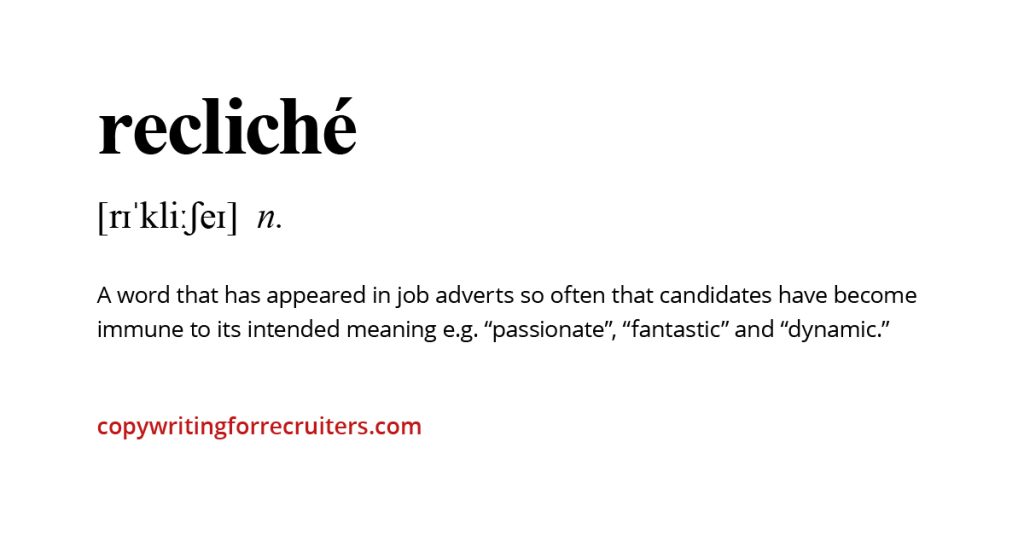
Recycling plastic is good.
When people regularly see you doing it, they’re gradually buying into the notion that you’re a good person who cares about the planet.
Recycling clichés is bad.
When people regularly see you doing this, they’re buying into the notion that you’re just like all those recruiters they’ve had bad experiences with. Every time they see another job ad that’s riddled with clichés, it just bolsters their belief that all recruiters are the same.
The good news is that they’ll probably forget your name. That’s not such good news for the industry as a whole though.
Recliché.
Something a recruiter uses when writing job ads that also helps destroy the planet. The recruitment planet.
“Human being needed. Must be able to speak and listen. Some experience in marketing would be desirable.”
Run that job ad and how many applications do you think you’d get?
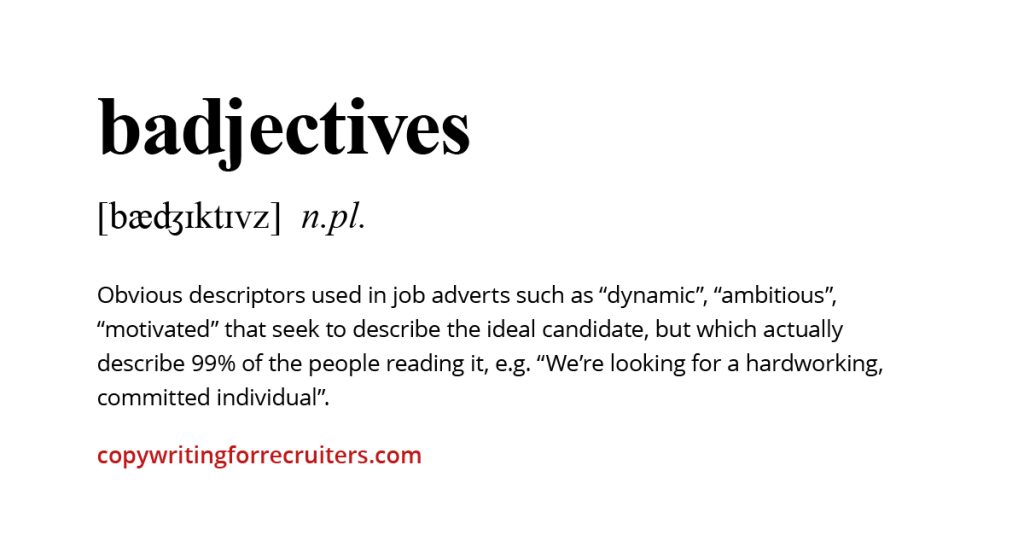
If we pull back from that particular nightmare scenario, describing your ideal candidate as “dynamic”, “ambitious” and “motivated” is pretty much speaking to every person who might be reading it.
Even if someone is a raging pessimist, has no ambition and needs to be kick-started every morning, that’s probably not going to stop them believing those adjectives describe them.
Where do you think all those candidates get the idea to put “I’m a hard-working, ambitious and dynamic person who can work individually and as part of a team” on their CV?
I’ll give you a clue. It wasn’t me.
Badjectives.
Words that recruiters love using, but hate when candidates use them.
Do you know why job boards tell recruiters to stuff their job ads with certain keywords and phrases?
It’s to boost their own Google ranking for that particular set of words.
The higher the job board’s Google ranking, the more likely that job board are going to attract more recruiters to spend money with them, posting job descriptions that probably aren’t going to work.
Job descriptions that are probably not going to work because the keyword stuffing has made them totally unfuckingreadable to any mildly intelligent human.
The only life form that actually likes content stuffed with keywords is an algorithm. It makes their life easier. It gives them more time to network with other algorithms and plan world domination.
Mildly intelligent humans on the other hand…
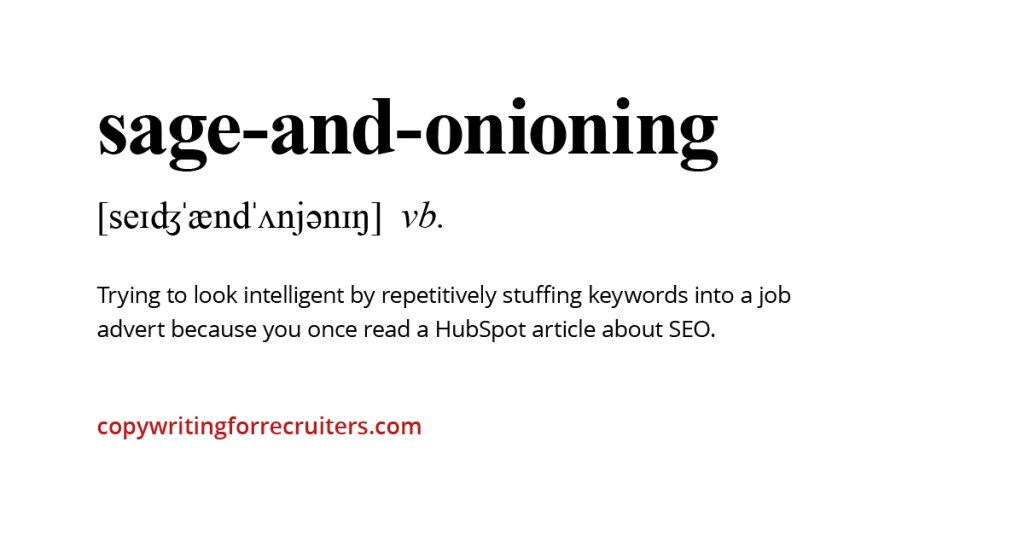
Sage-and-onioning.
Stuffing something that didn’t need (or want) to be stuffed in the first place.
Trevor’s an Accountant. He’s been one for about 15 years.
He’s sitting on the train home after a particularly bad day at work.
First, he was passed over for promotion. Then his boss behaved even more stupidly than usual. On reflection, Trevor has realised that he’s become stale and isn’t learning anything anymore.
So, he gets out his phone and starts looking at accountancy jobs.
He starts his search on Google, then trawls LinkedIn and visits his favourite job board. He searches ‘Accountant, London, £50K’. Trevor soon starts seeing job listings for accountancy jobs, in London, all paying £50K.
And what does he see when he clicks on the first one?
A job posting for an Accountant with a big list of tasks and responsibilities that include things like “preparation of statutory accounts” “corporate tax returns and computations”, “management accounts and VAT returns” etc.
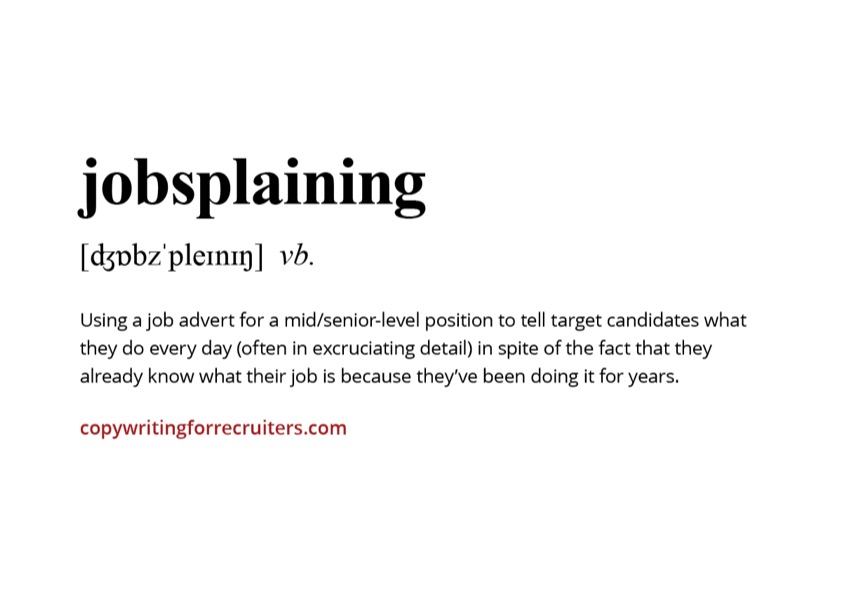
In other words, a job posting that explains what an Accountant does all day to an Accountant called Trevor who spends all day accounting.
Now Trevor knows what it’s like to be a woman who’s just had to listen to a man explain to her how to use hair tongs.
Jobsplaining.
Keeping people in jobs they don’t like for 20 years.
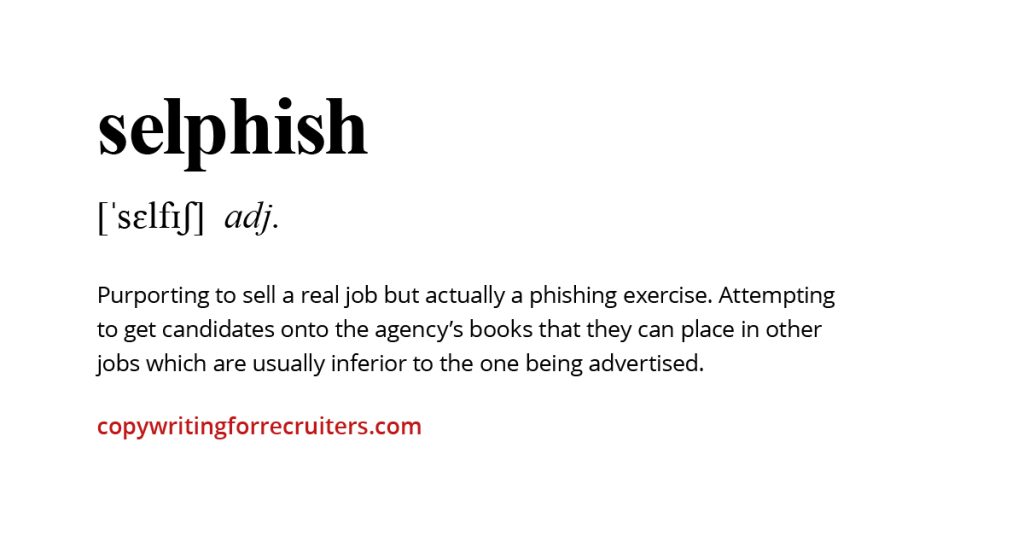
Phishing. Nobody needs that shit.
When I first came into recruitment, most of our candidates came from fake jobs. They were fake because each one was an amalgam of different jobs and were really just telling a certain type of candidate that the agency was open for business.
You could get away with that back in the print days. But not anymore.
Candidates have wised up.
They can see the signs; the weasel words and the clichés that say nothing. The same formulaic and vague content that so obviously screams ‘This isn’t a real job!’
There are only so many ways you can say nothing.
When potential candidates see job ads like this, they’re likely to imagine the agency as being full of recruiters that only care about themselves and who’ll probably treat them as a commodity.
Selphish.
If you still do this, you’re the Jesus of recruitment. “A Phisher of Men”
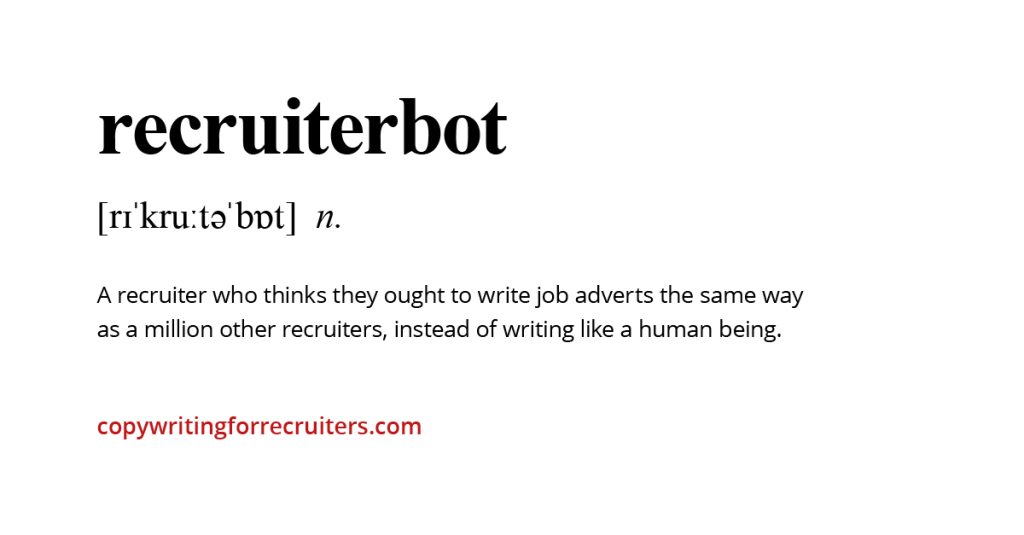
The age of the bot probably started back in the early 2000s.
That was when job boards became a thing and it was cheap to post hundreds of ads that were just cut-and-pastes of the clients’ job descriptions.
Then, whenever a fresh-faced graduate embarked on their career as a Talent Acquisition Consultant, on day one of their training they’d hear their new boss say; “This is how you post job ads, kiddo…”
Those fresh-faced grads that made it into management 8 months later, then taught the same thing to their own trainees.
That’s how shit gets ingrained.
Whenever one of those trainees asked questions like “Why do we have to post job ads this way?”, they were earmarked as being difficult or not really a team player.
And that’s how shit gets even more ingrained.
Recruiterbot.
A recruiter who’s been made to forget that they were once a human being. The collective noun for Recruiterbot is ‘a Shitstorm’.
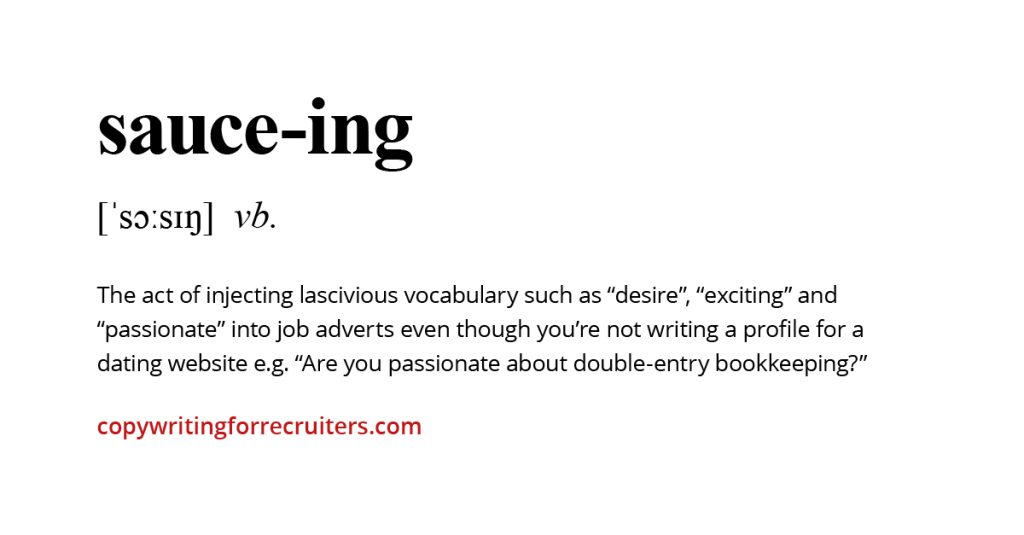
What would an excitable Accountant look like?
Someone who wets their pants when they see a profit-and-loss report?
What about a passionate Project-Manager? Someone who gets hot under the collar about Gannt charts?
Is that really the kind of applicant you want? No, of course not. Those kinds of people are nutters.
So why do your job adverts ask them to be “passionate” or “excited” about their jobs?
Sauce-ing.
The writing equivalent of trying to add flavour by splashing ketchup everywhere instead of choosing a better recipe.
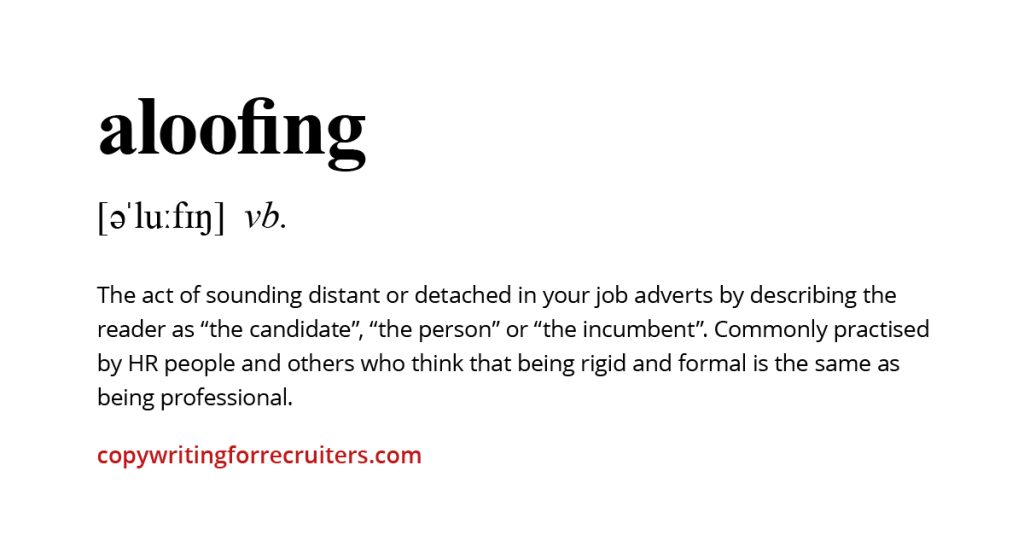
If you ever see a job advert use the term “the incumbent”, run, click away, swipe left.
Companies who talk like this hate you.
They see you as one of the great unwashed and they think they’re doing you a favour by having a job vacancy. They might have an HR department that are still called ‘Personnel’. Their Chairman probably has a handlebar moustache, reads The Telegraph and lives in Berkshire.
Companies that use “the incumbent” in their job postings are a throwback to the 1970s. Nobody wants to go back to the ‘70s because it was fucking horrible. Train strikes, 3-day weeks, power cuts every 10 minutes and Jimmy Savile.
Don’t look back.
Aloofing.
When your employment comms make you look even more antiquated and supercilious than you might actually be.
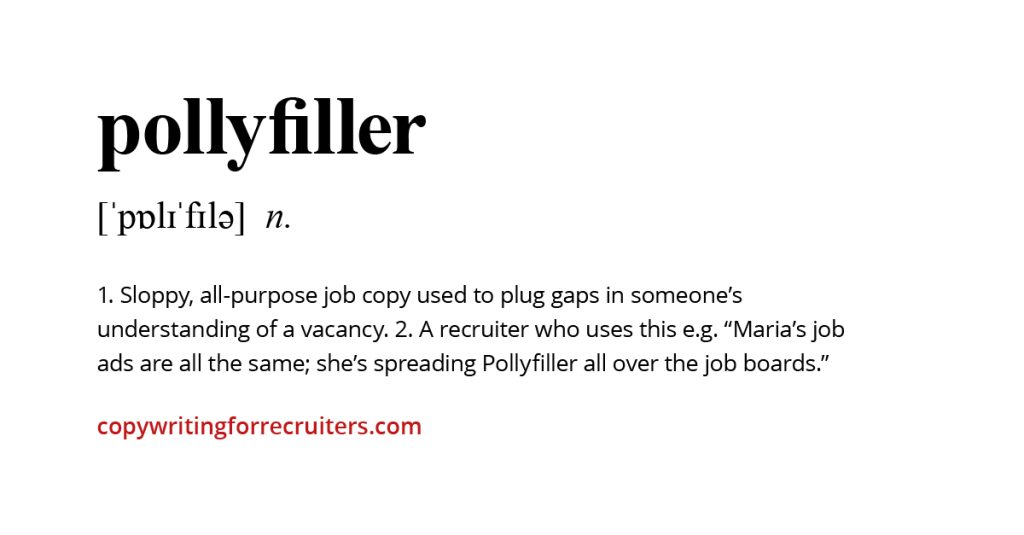
We’ve all seen the same tired and unimaginative language that’s been used in a million other job ads.
People think that’s the way it should be done. So, they repeat the meaningless adjectives, clichés and empty words in their own ads, parrot-fashion.
Pollyfiller
Parroting the same old rubbish that every other recruiter spouts.
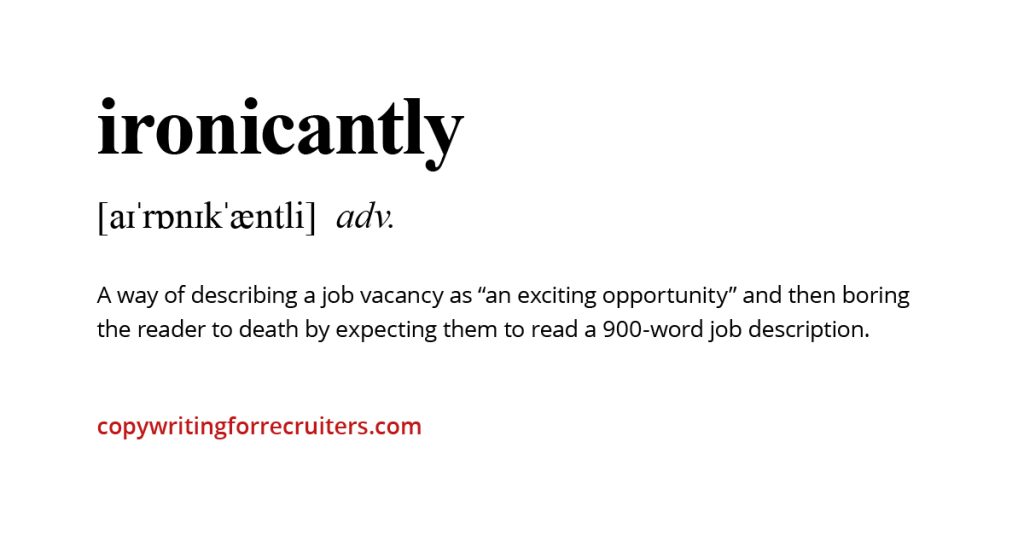
What’s really going on in the minds of recruiters who type out the words “this is an exciting job opportunity” then post what is essentially just a job description?
Are they expecting their target candidates to pore over long, boring content that has hardly any paragraph breaks to find little nuggets of information that might excite them?
“Ooh look, this company use Lotus Notes as their email system. That’s brilliant! I need to brush up on that because I haven’t used it in years.”
Ironicantly.
Confusing shit that’s posted in job adverts by Ironicants.
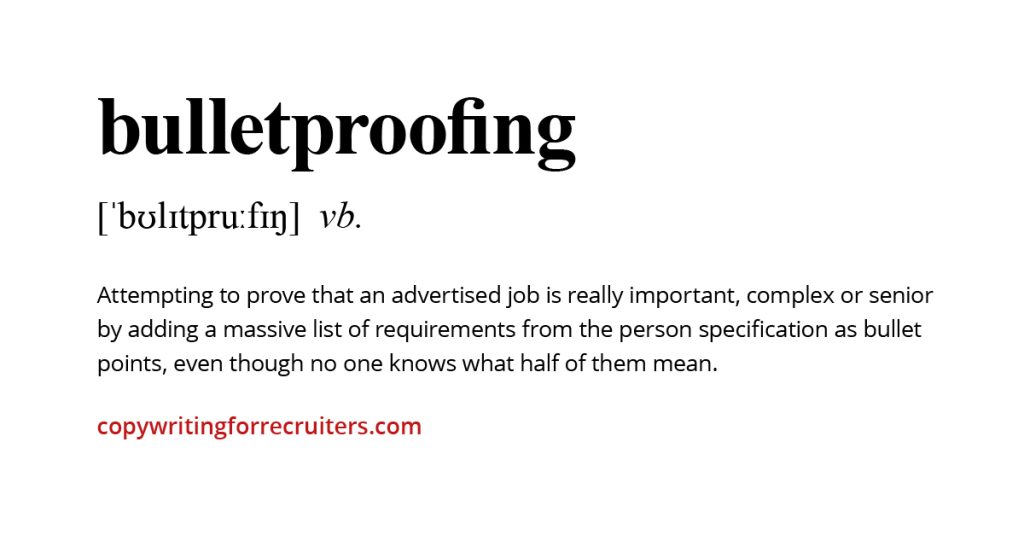
“Bullets are easier to read”, they said.
“The reader needs to know ALL the job requirements so they can decide whether to apply for the job”, they said.
“They”, more often than not, are a marketing intern. Someone whose only other work experience was selling discount bedroom furniture and who are now working for a job board and writing blogs teaching recruiters how to “write the perfect job ad”.
But does listing bullet points such as “Ad-hoc duties and assistance with projects”, “follow health & safety guidelines” and “supervising junior staff when required” really encourage more of the right candidates to apply?
No, of course it doesn’t.
And do you know why?
Because they didn’t read it, that’s why.
Bulletproofing.
When jobs are so easy to fill, all you have to do is cut-and-paste 2 pages of bullet points into a multi-poster, sit back and wait for your inbox to start pinging.
Sign up for my ‘Ad Lip’ newsletter for more stuff like this.
If you’re looking for more effective ways to attract candidates to jobs, take a look at my Copywriting Training Courses